
June 8, 1975: The Day Jackie Tonawanda Opened a Door at Madison Square Garden
Throughout the 1970s, Muhammad Ali was reinventing what a heavyweight champion could be and television was broadening the sport’s audience. Yet in New York, the nation’s boxing capital, a woman could not legally obtain a professional boxing license.
Into that landscape stepped Jackie Tonawanda.
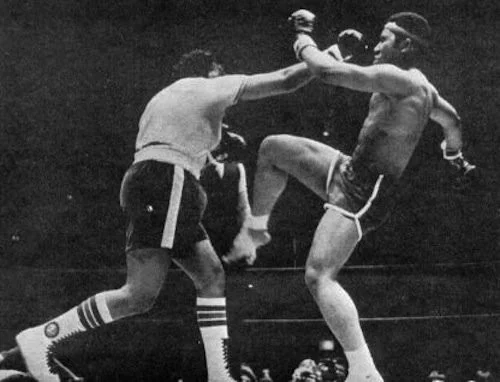
On June 8, 1975, Tonawanda entered Madison Square Garden as part of Aaron Bank’s “Oriental World of Self Defense” exhibition, a sprawling martial arts showcase that mixed demonstrations with competitive contests. Before the night was over, she would knock out kickboxer Larry Rodania in the second round and become the first woman to box inside the Garden. Although the bout was not an official professional boxing match, it was a public challenge to an establishment that insisted women had no place in the ring.
Born Jacqueline Garrett, Tonawanda was already a controversial figure before she ever stepped between the ropes at Madison Square Garden. She promoted herself aggressively, adopted the nickname “The Female Ali,” and claimed an extensive fighting background that has never been fully verified.
That uncertainty has complicated her legacy. Modern researchers have been unable to document most of the fights she said she had contested. Only one professional boxing match has been verified on her record, a six-round loss to Diane Clark in 1979. That being said, even critics acknowledge that Tonawanda was a genuine pioneer in the fight for women’s participation in professional boxing.
Accounts agree that Tonawanda ended matters in the second round with a left hand that dropped Rodania and secured the stoppage. Contemporary observers differed sharply on the bout’s legitimacy. Some accepted it as a genuine contest; others viewed it as more spectacle than sport. Decades later, veteran boxing writer Randy Gordon would recall attending the event and express skepticism about the knockout punch itself. Nevertheless, the result entered boxing folklore and remains part of Tonawanda’s historical résumé.
At the time, Tonawanda was engaged in a legal battle with the New York State Athletic Commission, which had denied women boxing licenses under Rule 205.15. The regulation bluntly declared that women could not be licensed as boxers in New York.
Tonawanda challenged that policy in court, and even though her lawsuit did not immediately legalize women’s boxing in the state, it created an important legal precedent. Two years later, when Cathy Davis mounted a similar challenge, courts relied in part on the groundwork established by Tonawanda’s case. By 1978, Tonawanda, Davis, and Marian Trimiar became among the first women licensed to box professionally in New York.
In that respect, the exhibition at the Garden was less a sporting event than a public argument. Tonawanda was effectively saying: if women cannot get licensed, then watch me perform anyway.
For Tonawanda, the impact of that night was profound. The image of a woman knocking out a man in Madison Square Garden generated headlines at a time when women’s boxing was fighting for recognition. Tonawanda’s legal battles, publicity campaigns, and willingness to challenge convention helped keep the issue alive until licensing barriers began to crumble. Her actual fighting résumé remains a matter of debate, but her place in the story of women’s boxing does not. Jackie Tonawanda is recognized by the International Boxing Hall of Fame as a Women’s Trailblazer inductee, citing her role in the struggle for women’s boxing rights in New York.

We thank you for your support.
You can find us on facebook: ThePrizefighters.com
And on X: @TPF_ib_tv